01
Origin condition
Why it exists
Quantum software often blurs simulation, emulation, cloud access, and physical execution. QForge exists to make execution class and evidence impossible to hide, so a useful workstation can explore quantum workflows without laundering virtual results into hardware claims.
Can one workbench support learning and experimentation while preserving the difference between simulated and physical quantum execution?
02
Working system
What it does
- QRuns classified workloads
Labels execution from E0 conceptual work through E5 verified physical execution.
- MIUChecks model integrity
The Model Integrity Unit records backend identity, assumptions, noise, compilation, and evidence.
- ⌁Preserves run receipts
Every circuit, backend choice, transformation, result, and interpretation can be retained as a lineage record.
03
System anatomy
Architecture
QForge combines a circuit workspace, execution-class governor, virtual and physical backend adapters, Model Integrity Unit, and result ledger.
Workbench
Circuit, algorithm, dataset, and notebook authoring.
Execution governor
E0–E5 classification and backend eligibility rules.
Backend adapters
Transparent simulator first; physical providers only through verified connectors.
Model Integrity Unit
Receipts for transpilation, noise model, backend, measurement, and interpretation.
04
Present tense
Current state
QForge is recorded as Exploring at the Sprout stage. The inventory currently marks 4 artifact lanes Ready, 2 Partial, and 2 Missing.
B3 Tier 1 room draft · Core canon · Research-grounded evidence · public candidate
05
Honest edges
Known limitations
- No physical QPU integration or verified E5 run is represented in the current portal record.
- Simulation fidelity depends on the stated model and cannot reproduce every hardware effect.
- Quantum advantage is workload-specific and is not assumed.
- Provider terms, cost, queueing, privacy, and export controls would require separate review.
06
Claim boundary · v1.1.0
What we are—and are not—saying
A master architecture, execution classes E0–E5, virtual/physical state distinction, Model Integrity Unit, and no-trust-laundering rule have been specified.
QForge is not represented as a physical quantum computer, proof of quantum advantage, certified benchmark platform, or substitute for provider verification.
07
Development memory
Ledger
B3-QF-001-01Virtual and physical QPU states separated in the QForge design.
✓ DocumentedB3-QF-001-02Execution Classes E0–E5 and Model Integrity Unit defined.
✓ DocumentedB3-QF-001-03Tier 1 workbench room drafted with transparent simulator-first boundary.
✓ DraftCurated project receipts · source-file binding and human review remain pending
08
Directional, revisable
Roadmap
Freeze the execution receipt
Define the minimum metadata required for every E0–E5 result.
Build the transparent simulator
Create a local demonstration that never labels simulation as hardware execution.
Add verified provider adapters
Integrate physical backends only when identity, custody, cost, and evidence can be recorded.
10
B10 evidence trail
Featured evidence
Registry-grounded trail
No primary source package is bound yet. The public trail is limited to the verified field card and public Genome snapshot.
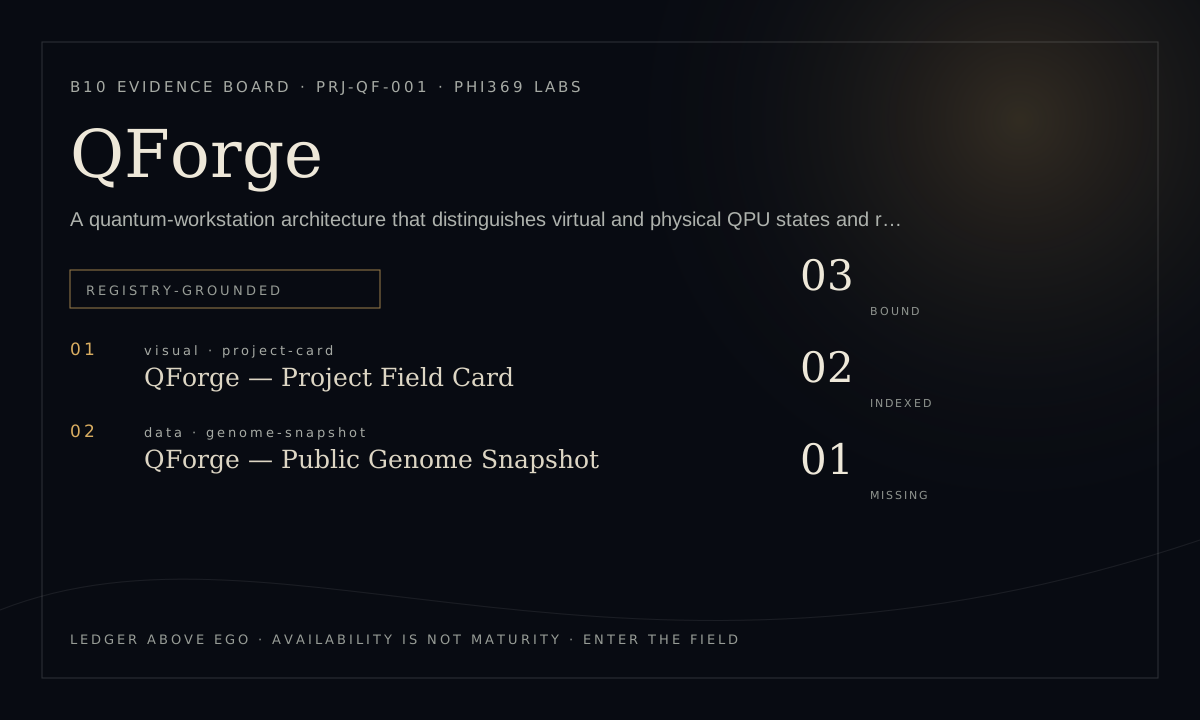
QForge — Project Field Card
B4-generated visual identity card built directly from the reviewed constellation registry.
Open bound artifactQForge — Public Genome Snapshot
Public-safe JSON snapshot of the current project registry or expanded Project Genome.
Open bound artifact11
Publication intake
Artifacts & sources
QForge Master Architecture
Execution classes, MIU, and backend boundaries.
View archive recordarchive:intake/qforge-master-architectureTransparent local simulator
Planned first executable demonstration.
View archive recordarchive:intake/qforge-simulatorExecution receipt schema
Core fields are designed; canonical machine-readable form remains to be frozen.
View archive recordarchive:intake/qforge-execution-receiptSource basis
archive:intake/qforge/source-basisarchive-canonportal:project/qforge@v0.4-b3planning-inventoryReview: Canon, claims, privacy, accessibility, and publication review · pending
12
Move with evidence
Next actions
Every result should tell you what actually executed, where, and under which assumptions.
reviewReview the artifact registerSee which source packages, visuals, demonstrations, and public links are actually ready.
secondaryTrace related projectsFollow documented dependencies and neighboring systems without inventing connections.